Diagnosis
The category was missing for a reason.
The contemporary visual field is undergoing a steady loss of order. Images are produced far faster than they can be absorbed. Meaning is diluted by replication. Form is weakened by distribution. Decoration conceals structure. Speed overwhelms order. ESTRA calls this condition visual entropy.
Entropy here is not a metaphor. It names an observable degradation: when the supply of symbols expands without limit while the physical work behind them remains unchanged, the amount of reality each symbol carries declines.
With the rise of AI-driven image generation, that degradation enters a second phase. What was once symbolic inflation becomes visual hyperinflation. Algorithms produce flawless, weightless images at negligible cost and machine speed. Aesthetics is flattened into an infinitely replicable stream of visual data.
On screen, everything is smooth. Where there is no physical resistance, there is no chain of cause and effect. ESTRA calls this phase algorithmic entropy.
Entropy also takes on a visible social form. As images multiply exponentially, judgment is outsourced to metrics, and attention is conditioned for immediate reward. The subject's capacity for complexity and delayed gratification begins to atrophy.
Judgment begins less with the object itself and more with price, identity, ranking, and prior consensus. Tolerance for complexity declines. Difference narrows. Depth yields to immediacy. The chain of evaluation slides from "comprehension — judgment — consensus" toward "exposure — interaction — conversion." ESTRA calls this condition structural aesthetic atrophy.
This degradation is driven by a closed loop: capital sets low-risk boundaries and rewards predictable mediocrity; platforms reward replicable, low-density stimulation, forcing objects to flatten themselves for distribution; group psychology aligns identity through recognisable signals, placing a continuous tax on imagination.
All of these tendencies converge on the same underlying condition: existential weightlessness.
Objects still look like objects, yet they increasingly function as flat image surfaces meant to be photographed. Physical resistance disappears. The chain of cause and effect breaks.
It is not only the object that loses fidelity. Judgment loses fidelity with it. When objects no longer carry structure and time, people find it increasingly difficult to anchor themselves to anything of real weight.
Weightlessness is therefore not merely a visual condition. It is the simultaneous loss of weight in objects and selves.
Response
Existential weightlessness is the diagnosis.
ESTRA does not respond with another surface. It responds by returning to the object the realities that have been designed out of it.
As the world rises into the cloud, the response must return to the ground.
AI can generate ten thousand flawless product images. It cannot generate a gram of weight. It cannot generate a second of real oxidation. It can replicate appearance. It cannot replicate resistance. It cannot replicate the traces left by work.
In this context, physical structure is no longer merely a container. It is a breakwater against the virtual flood.
This is not another style. It is a method.
Structure leaves its reasons on the object. Time writes life into the object. The former resists distortion. The latter resists hollowness.
If this response is to hold, it cannot remain an attitude. It must become a way of making objects.
Definition
In ESTRA's practice, this method takes form as a set of working principles.
ESTRA makes objects by joining two opposed conditions: the constant and the living.
The constant is structure: a load-bearing skeleton designed to resist degradation in use. It bears weight, locks geometry, and resists deformation.
The living is trace: a surface material that changes irreversibly over time, continuously marked by light, oil, friction, and oxidation. It ages, absorbs, and records.
The former provides reason. The latter provides life. Their coexistence is not a compromise. It is the condition under which an object acquires life.
Within this framework, the object is no longer a passive container. It becomes an active carrier that records passage and bears witness to existence.
ESTRA therefore asserts the right of objects to age. Scratches, oxidation, and discolouration are not defects. They are not forms of deterioration to be prevented. They are the legitimate way an object participates in time. To allow an object to age is to acknowledge that it has lived.
When the structural skeleton can be read by the eye, confirmed by touch, and recognised by sound, any added symbol becomes redundant. ESTRA therefore does not use a logo as its primary mark of identification. The structure itself is the identification system.
Objects made under this framework cannot be accurately placed in any existing category. ESTRA therefore provisionally names them Tectonic Objects — objects whose value is carried by physical structure and whose life is completed through the right to age.
This is not a final classification. It is a working label, introduced to the market by ESTRA LABS and left open to refinement through practice.
The Object
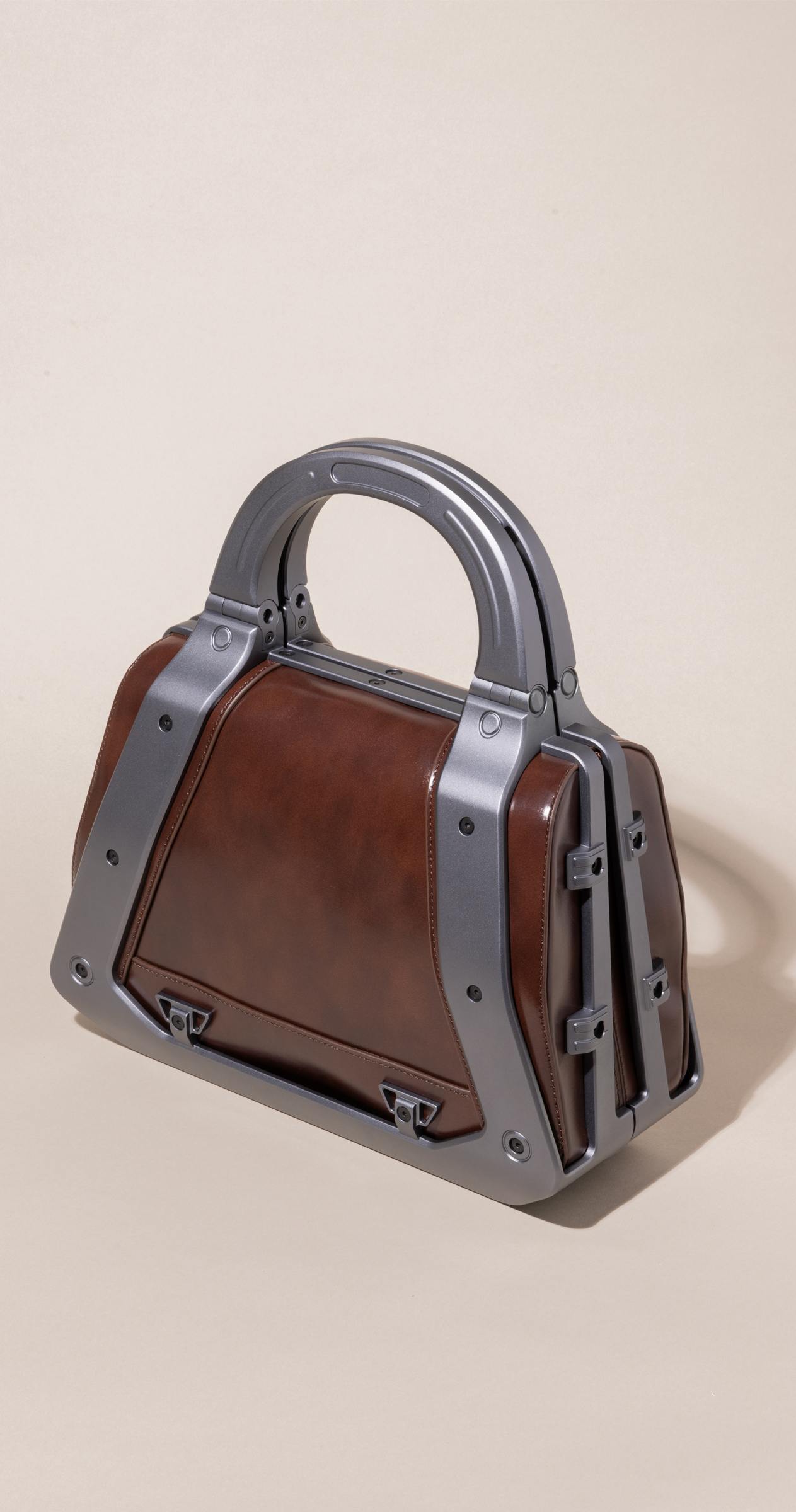
Every ESTRA object is a piece of portable micro-architecture.
It is organised through three roles: bone, flesh, and void.
The metal skeleton sits on the outside. It is not a badge. It is a load-bearing system. It defines boundaries, holds geometry, secures closure, and resists deformation. Leather is held within the skeleton, not wrapped around it. The designed gaps between the bones are not empty space. They are the third structural element: void, giving the object air and making the contour of the skeleton legible. The skeleton preserves order. The leather receives time. The void makes their relation legible.
Its structural logic is not concealed. What is visible is not decoration. What is visible is how it stands.
It reads cold to the eye and warm to the hand. The skeleton remains rigid while contact stays forgiving. This is not a compromise. It is one object meeting, at once, the conditions of structure and body.
Confirmation does not happen through sight alone. It happens in the hand and in sound. The low, definite, dense sound of the clasp closing is not an effect. It is the outcome of damping, tolerance, and mechanical engagement. An approximate mechanism sounds approximate. A resolved mechanism sounds resolved.
Time is permitted to enter from the beginning. But the entry of time does not mean the surrender of structure.
Grip surfaces soften. Contact areas deepen. Lustre migrates. Fine scratches and oxidation gradually appear. These are not defects. They are not aestheticised wear. They are simply the result of use.
The skeleton holds its form. The leather records its history.
This is not a style. It is a single object answering, in physical form, to structure, body, and time at once.
Philosophy
ESTRA does not judge an object by its surface. Nor does it build an object from the surface inward. Structure comes before surface. Structure is not style. It is the starting point.
When the skeleton of an object can already be read by the eye, confirmed by touch, and recognised by sound, appended marks no longer carry the primary burden of identification. The logo is not rejected. It simply stands second. Recognition is determined not by a symbol applied first, but by a structure established first.
Structure therefore remains primary. It determines proportion, load path, connection, and how an object first comes to stand.
Structure does not exist to keep time out. It exists to let time in without collapse.
Use, friction, oxidation, fine scratches, localised softening — these changes are not contamination, nor are they wear romanticised as beauty. They are time's inscription on the object. Trace is not a theory. It is physical evidence left by action.
What matters is neither the rejection of time nor its indulgence, but the admission of time into structure on legitimate terms.
What ESTRA cares about has never been how new an object looks. It is whether the object has been honest enough to remember you.
Structure and time are not parallel aesthetics. They work together.
Structure maintains order. Time applies pressure. The former lets an object withstand existence. The latter lets it deserve to be remembered.
If there is only structure and no work of time, the object becomes a sterile specimen. If there is only the work of time and no structure to bear it, the object collapses into meaningless ruin. Only when the two remain in tension without cancelling one another does an object acquire real weight.
This weight is not merely physical mass. It is the existential weight generated after an object has done real work and left behind traces that cannot be replicated. Not price. Not scarcity. Not external consensus.
ESTRA does not seek value in the accumulation of decoration. It seeks the generation of weight.
Position
Weight returns to the hand. But not everyone is looking for weight.
ESTRA's objects do not explain themselves. They do not simplify themselves in order to be accepted more quickly. They ask for a particular willingness: to read structure, to wait for time, and to locate value in physical fact rather than symbolic consensus. This is not a selection. It is alignment. The issue is not whether everyone agrees, but whether the object stands as a physical fact.
No existing market hierarchy accurately describes the position ESTRA occupies. Established tiers are classified by price, provenance, heritage, or style. ESTRA's value anchor — structural evidence and temporal truth — does not sit on any of those axes. ESTRA therefore provisionally names its position the Tectonic Field: a space defined not by price band but by where judgment begins. Within this field, judgment does not begin with what a brand claims an object is worth. It begins with what can be read directly from structure and time. The object provides the reasons first. The external apparatus comes second.
The relation between the two names is structural. Tectonic Object designates a way of making. Tectonic Field designates the space in which that way of making can be read on its own terms. Neither is a final classification. Both are working names: let the object stand first, let time enter, and let the market determine whether the field holds.
ESTRA's position is therefore not "more expensive" and not "more niche." It is a field of judgment — formed by structural evidence, temporal truth, and the willingness to pay attention. ESTRA does not add another rung to an existing hierarchy. It attempts to name a space that has long existed but has never been accurately defined, and leaves the object to bear its weight.
Evidence Proposition
The prevailing value system anchors worth in symbol, narrative, provenance, heritage, and social consensus. It functions effectively. It has historical legitimacy. It responds to real human needs.
ESTRA does not deny it.
What ESTRA observes is the existence of a separate demand. There is another mode of judgment that begins not with symbol but with physical fact. It asks not what narrative has been assigned to an object, but what the object has done structurally, what it has recorded in time, and whether these things can be seen, traced, and examined again. This demand is not superior. But it is real, and it is not yet accurately served.
ESTRA therefore puts forward an experimental proposition: that value may be anchored in verifiable structure and temporal fact, rather than left to rest on symbol alone.
This is not a correction of the existing system. It is a parallel proposal. Whether it holds depends on whether the market confirms that this demand is real, and on whether ESTRA's objects respond to it with sufficient honesty.
So long as value is anchored in verifiable structure and temporal fact, verification is not supplementary. It is the operating condition of the proposition itself.
Within this proposition, structure is no longer only what allows an object to stand. It becomes a primary ground of value judgment. Time, in turn, prevents that ground from remaining a static claim by subjecting the object to continuous examination through real use. Every structural assertion — concerning load, connection, or material selection — must correspond to registrable industrial evidence. Every temporal assertion — concerning ageing or the legitimacy of trace — must correspond to traceable physical change. The structural evidence exists before the object enters use. The temporal evidence begins only after it does. Assertions that cannot be verified are not permitted to enter any external narrative. Without verification, structure reverts to being just another symbol.
This form of argument does not follow an established path in a commercial space. How it will be received is not known in advance. But an object that cannot be placed in any existing category either remains silent or states its own terms — because the same chain of reasoning that produced the object requires its conditions to be made legible.
ESTRA places itself in a position that can be falsified. Its claims either withstand re-examination, or they do not. This is the contract it holds with its own logic.